


The Pys Headache Method
Headache disorders are commonly approached as chemical, hormonal, genetic, or stress-related conditions. Medication is often prescribed. Triggers are discussed. Lifestyle modifications are recommended.
These approaches may provide relief. However, in many chronic cases, the mechanical component is not fully evaluated.
The Pys Headache Method is based on 31 years of extensive clinical experience, combined with ongoing active research and continued professional study in manual therapy and headache-related disorders.
Mechanical Considerations
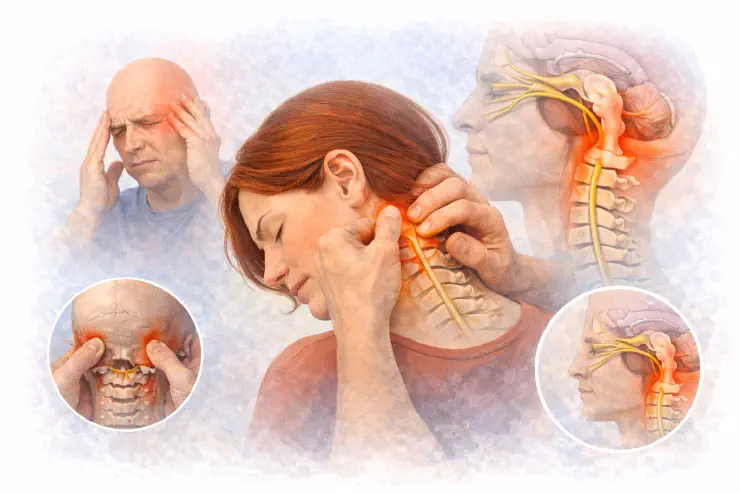
The head is supported by the upper cervical spine — particularly the C0–C3 region. Its function depends on a coordinated relationship between the occiput, atlas (C1), axis (C2), C3, surrounding musculature, fascial continuity, and neural structures.
When motion becomes restricted or imbalanced in this region, compensatory tension patterns may develop. Over time, these patterns can contribute to persistent pain cycles.
This may be relevant in patients with:
Imaging studies may appear normal. Mechanical dysfunction often does not.
Triggers and Mechanical Vulnerability
Patients are frequently told their headaches are caused by:
These factors can act as triggers. A trigger does not necessarily create the condition. It often reveals an existing mechanical sensitivity within the C0–C3 complex.
When upper cervical mechanics are stable and adaptable, external stressors are often better tolerated. When mechanical strain is present, the same stressors may provoke pain more easily.
Addressing mechanical vulnerability does not replace medical management. It may complement it.
Clinical Approach
The Pys Headache Method emphasizes:
Clinical Philosophy
The body adapts to stress. Persistent adaptation can lead to compensation. Compensation alters movement patterns. Altered movement can sustain pain. When appropriate, mechanical problems should be addressed with mechanical solutions.

 181 Waukegan Road, Suite 103, Northfield, IL 60093