


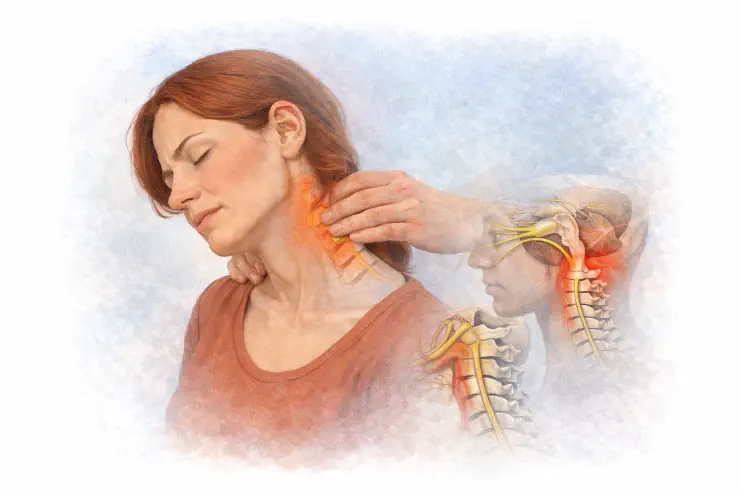
A Mechanical Approach to Understanding Head Pain
I am not a medical doctor. I practice Osteopathic Manual Therapy. For more than 30 years in Northfield, Illinois, I have worked with people who live with headaches — migraines, tension headaches, cervicogenic headaches, and many forms of persistent head pain.
Over the years, I have noticed something consistent:
Many headaches are not random.
Many headaches are mechanical.
That does not mean they are “just muscle pain.” It means the structure of the neck, upper spine,
shoulders, and base of the skull often plays a significant role in how the nervous system reacts.
When mechanics improve, symptoms often improve.
What Is OMT?
According to the Cleveland Clinic, Osteopathic Manipulative Treatment (OMT) is a hands-on
approach used to diagnose, treat, and prevent illness or injury by improving motion in muscles
and joints.
In simple terms, it is precise, gentle work with the hands.
In headache patients, that often means addressing the upper cervical spine, the base of the skull, the jaw, and the shoulder girdle — even when the patient does not report neck pain.
Many people with migraines will tell you, “My head hurts, not my neck.” Yet when the upper neck is evaluated, restriction is often present.
The Mechanical Component of Headaches and Migraines
Many people are told their headaches are:
Those factors absolutely can play a role. But what I often see clinically is this: A sensitized nervous system sitting on top of restricted mechanics.
The nervous system becomes more reactive. When it becomes more reactive, smaller triggers produce larger reactions.
In that situation, wine may trigger a headache. Stress may trigger a headache. Poor sleep may trigger a headache. But the system was already irritated.
A Story From My Book
I once worked with a successful attorney — busy life, two children, very disciplined. On vacation, she would allow herself a glass of wine with dinner.
Almost every time, she woke up the next morning with a headache. Sometimes a migraine. So she stopped drinking wine.
One day I asked her a simple question: “What if you have a glass tonight, and we see what happens? I’ll see you in the morning.” She smiled and said, “You’re guaranteeing I’ll have a headache.” The next morning she walked in with a 5 out of 10 headache. “See?” she said. “It’s the wine.”
I worked gently — mostly the upper neck, shoulders, and the base of the skull. No force. No dramatic adjustments. Just focused, precise mechanical correction. About 30 minutes later, her headache was gone.
What changed was tension. What changed was mechanics. What changed was how her nervous system was being stimulated.
Was wine a trigger? Possibly. But a trigger is not always the root cause. Often, the body is already irritated — and the trigger is simply the last straw.
What Happens During Treatment?
An evaluation typically includes:
Treatment may include:
Patients remain fully clothed. The techniques are controlled and specific. Most people describe them as firm but comfortable. This is not aggressive treatment. It is deliberate and anatomical.
What Patients Commonly Notice
Patients often report:
Not everyone improves the same way. Headaches are complex and layered. But when there is a mechanical driver, addressing it can make a meaningful difference.
Safety
OMT is considered one of the safest forms of hands-on medicine when performed by a properly trained practitioner. As described by the Cleveland Clinic, mild soreness can occur after treatment, but serious complications are rare when care is appropriately applied.
Every patient is screened carefully. Some medical conditions require co-management with a physician, but most patients can safely receive care.
An Important Clarification
OMT is not an emergency treatment.
Sudden severe headaches, headaches with neurological symptoms, fever, trauma, or a new and unusual pattern of pain require immediate medical evaluation. Manual therapy is not a substitute for necessary medical care. It is a structural approach that may be part of a comprehensive plan.
My Clinical Perspective
After decades of working with headache patients, I do not believe headaches are “all in the
head.”
Very often, they are in the neck. Not psychologically — mechanically. In my clinical experience, a large percentage of persistent headaches have a significant upper cervical component.
The upper cervical spine has one of the strongest neurological relationships with the brainstem and the trigeminal system — one of the primary pathways involved in head pain. When upper cervical mechanics are disturbed, that system can become more sensitive.
When mechanics improve, irritation often decreases. That does not mean every migraine disappears. It does not mean every trigger becomes irrelevant. But it often means the threshold rises. And when the threshold rises, life becomes more manageable.
Final Thoughts
Headaches are rarely caused by one single factor.
They are usually layered:
There are different forms of stress — physical, emotional, chemical, hormonal. But the tissue response to stress is often similar: increased tension and spasm.
We cannot control everything. But we can often improve how the neck and upper spine function. When structure improves, function often follows. If you suspect your headaches may have a mechanical component, a careful evaluation can help
determine whether Osteopathic Manual Therapy is appropriate for you.
Sometimes the problem is not what you think it is.

 181 Waukegan Road, Suite 103, Northfield, IL 60093