


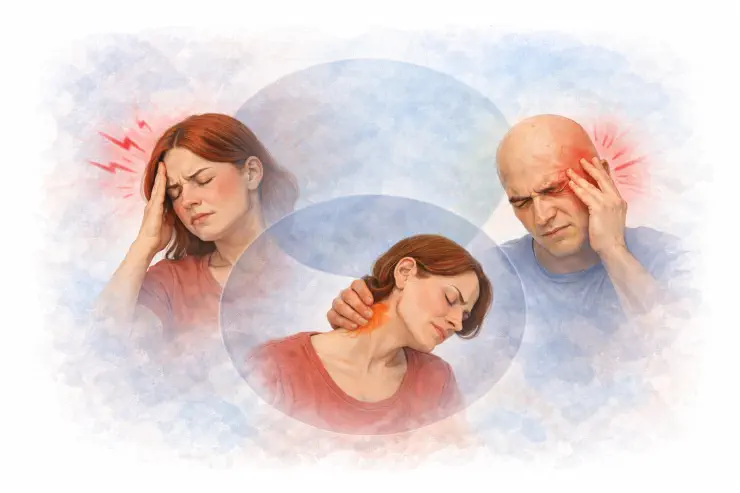
By the mid-20th century, with the rise of pharmacology, strict definitions became important for drug trials. The International Headache Society (IHS) published the first International Classification of Headache Disorders (ICHD) in 1988. It set criteria for diagnosing migraines, tension-type headaches, and others — entirely based on symptoms such as duration, frequency, pain quality, and associated features.
This system expanded. Today, the ICHD recognizes over 300 types and subtypes of headaches. But this raises a critical question: are there truly 300 different causes of headache, or are we slicing the same problem into endless categories of symptoms?
The reality is that many of these categories overlap. A patient labeled with “chronic migraine” might look nearly identical to someone with “cervicogenic headache.” Another patient might meet criteria for multiple categories depending on the day.
The Problem with Symptom-Only Diagnosis
Headaches are not like infections, where a lab test can identify the bacteria. They are complex, with overlapping pathways. Two patients with completely different causes may have the same symptoms. The following examples may both describe pulsating pain on one side with nausea, yet have totally different causes:
Upper cervical dysfunction (C0–C3) from joint restriction, muscle imbalance, or ligamentous irritation sensitizing the trigeminal-cervical nucleus in the brainstem. In my opinion this is the #1 overlooked cause in tension-type, cervicogenic, and migraine
headaches.
Brainstem hypersensitivity/central sensitization often develops from long-term neck dysfunction, trauma, chronic stress load, or repeated headaches. This is why symptom-based diagnosis often fails patients. It doesn’t explain the “why”. It only
describes the “what”. Doctors treat the label (migraine, tension, cluster, chronic daily headache)
instead of investigating the deeper structural or neurological contributors.
Case Story: Susan
Susan had been chasing relief for years. Every doctor told her the same thing: “You have migraines.” She tried pills, injections, diets, and lifestyle changes. Some helped a little, but the pain never left. She began to wonder… “Is it really migraine, or have I just been given a label because no one has looked deeper?”
The truth is symptom-based diagnosis is convenient for the system but often misleading for the patient. Doctors know this. Many want to dig deeper. But the modern medical system isn’t built for it. Time is limited, resources are scarce, and insurance structures reward quick labels, not thorough exploration.
When Susan finally tried osteopathic manual therapy, the approach was different. Instead of treating her migraine as a generic symptom, her posture, neck alignment, and muscular tension were carefully evaluated. Subtle dysfunction in her upper cervical spine, even though she did not have neck pain, revealed the true source of her headaches. With treatment, her pain eased and for the first time in years she felt free. Susan’s story is not unique. It illustrates the larger truth: the label is not the answer. Symptoms are the surface. Causes live deeper.

 181 Waukegan Road, Suite 103, Northfield, IL 60093